Talking With Tech AAC Podcast
Join speech-language pathologists Rachel and Chris as they discuss supporting complex communication needs with alternative and augmentative communication (AAC) and assistive technology!
Listen on:



Episodes
Tuesday Jul 24, 2018
Tuesday Jul 24, 2018
Rachel, Lucas, and Chris are joined this week by Dr. Calum Hartley, Professor of Psychology at Lancaster University. Dr. Hartley’s research focuses on why some young children with autism spectrum disorder (ASD) and complex communication needs may have a difficult time learning the meaning of pictures (e.g., icons, drawings, photographs). One reason a child with ASD may understand one picture over another is its “iconicity,” or how closely the picture resembles its referent (i.e., what the picture is intended to look like). Rachel, Lucas, and Chris open the episode by discussing why iconicity is important to AAC and how it influences communication. The team then discusses why teaching children the meaning of pictures is so important, and situations in which they would (and would not) consider replacing icons with photographs on a speech-generating device. Finally, Lucas and Rachel sit down with Dr. Hartley to discuss his research into ASD, iconicity, and symbolic communication. Dr. Harley and the team provide a fascinating look into picture comprehension, why understanding language is closely connected to understanding pictures, and how we can use iconicity to improve our AAC interventions.
Questions answered this episode include: Why do some children understand photographs more easily than drawings? How do children with ASD learn about pictures in unique ways? How can we use iconicity to improve our AAC interventions? How can we support learning the meaning of pictures? What makes core words less iconic than fringe words?
We want to know what you think! Join us on Facebook at Talking with Tech and on Twitter and Instagram (@talkingwithtech). Also, please subscribe and post a review on iTunes - it helps others to find us!
Hartley, C., & Allen, M. L. (2015). Iconicity influences how effectively minimally verbal children with autism and ability-matched typically developing children use pictures as symbols in a search task. Autism, 19(5), 570-579.
Hartley, C., Trainer, A., & Allen, M. L. (2017). Investigating the relationship between language and picture understanding in children with autism spectrum disorder. Autism, 1362361317729613.

Tuesday Jul 17, 2018
Tuesday Jul 17, 2018
In this episode, Rachel, Lucas, and Chris first discuss the work/life balance for SLPs, including the integration of social media into our professional lives and the need for balancing career growth vs. personal time when pursuing work-related interests.
Then, Chris is joined by school-based AAC Specialist Tabi Jones-Wohleber! Tabi is creator of “Model as a MASTER PAL”, a training series that emphasizes the importance of environment and the communication partner’s responsibility to model. Tabi shares about coaching others to be an effective communication partner, the need to create more naturalistic communication opportunities, and why it is important to speak in statements, not just questions, to people who use AAC.
Questions addressed this episode include:
How can we better balance our jobs and side projects with the need to take time for ourselves?
When is (and isn't) social media an important tool for SLPs looking to connect?
How can we better motivate AAC users to engage with communication partners?
How can we better structure lessons to provide communication opportunities all day long?
What do communication partners need to know to model more effectively?
We want to know what you think! Join us on Facebook at Talking with Tech and on Twitter and Instagram (@talkingwithtech). Also, please subscribe and post a review on iTunes - it helps others to find us!
Tuesday Jul 10, 2018
Tuesday Jul 10, 2018
In this week’s episode, Rachel, Lucas, and Chris are joined by Rachael Langley, AAC specialist, educator, and co-founder of the #TalkingAAC Conference. Rachael Langley is also a well known resource for AAC information on Facebook (@RachaelLangleyAAC). Rachael discusses her experience co-founding a successful conference, shares about working as an AAC specialist in the schools, and speaks about her experience using social media and online groups to spread the word about AAC implementation!
Questions addressed this episode include: Why is it important to start conversations about AAC with others? What is one of the biggest roadblocks to working with AAC in the classroom? How can we help teachers, staff, and parents increase modeling with AAC users? How can we help parents and teachers who are afraid of "doing it wrong" when they are modeling AAC?
We want to hear what you think! Join us on Facebook at Talking with Tech and on Instagram and Twitter (@TalkingWithTech). Also, please subscribe on iTunes and give us a rating - it helps others find us!
Tuesday Jul 03, 2018
Tuesday Jul 03, 2018
Rachel, Lucas, and Chris are joined this week by the amazing Carole Zangari! Dr. Zangari, co-founder of the Praactical AAC website and professor of speech-language pathology at Nova Southeastern University, shares some of her ideas about improving the experience for pre-service (i.e., unpaid and new to the field) teachers and SLPs who work with AAC users. The team also discusses the need for greater funding for AAC research, ways that people can get involved in AAC education, and the importance of implementation science. Carole then shares about her journey building Praactical AAC (praacticalaac.com) into one of the most well-known and widely-used AAC resources available!
Questions addressed this episode include: How can we educate graduate students about AAC in a more meaningful way? How can SLPs and teachers promote more evidence-based AAC implementation? What areas of research should we be focusing on next? What can SLPs and teachers do to get started sharing their AAC expertise with others?
We want to hear what you think! Join us on Facebook at Talking with Tech and on Instagram and Twitter @talkingwithtech. If you haven't yet, please subscribe and write us a review, it will help others find us!
Tuesday Jun 26, 2018
Tuesday Jun 26, 2018
Rachel, Lucas, Chris, are joined by SLP, author, and AAC consultant Susan Berkowitz for a discussion of how to help AAC users maintain their communication skills during the summer months (and any other break from school). Topics include: What is the "summer slide"? How can parents support AAC best during the summer? Do devices need to go home with students in the summer? How can parents support language during play activities? Finally, Susan discusses her work creating and sharing online resources through her blog, kidzlearnlanguage.blogspot.com. Learn more about Susan at susanberkowitz.net.
We want to hear what you think! Join us on Facebook at Talking with Tech and on Instagram and Twitter @talkingwithtech. Don't forget to subscribe and give us a rating on iTunes!
Tuesday Jun 19, 2018
Tuesday Jun 19, 2018
This week Rachel, Lucas, and Chris talk about their upcoming presentations on autism, AAC, education, and, yes, escape rooms at AAC in the Cloud and the Assistive Technology Industry Association. Then, Rachel and Lucas sit down with Gideon Grossman, engineer and inventor of Noisybands, a talking bracelet that is activitated by a high five! Gideon discusses his device, how they could be used in play and therapy, and his plans for developing them into an assistive technology device in the near future.
After earning a mechanical engineering degree with Honors from Princeton University, Gideon has worked as a mechanical, electrical and software engineer at innovative startup companies around the world from Manhattan to Tel Aviv, Maui and San Diego. He has helped design counterterrorism robots, genetic sequencing machines, app connected security systems and rugged training equipment for Olympic athletes. You can find out more about Gideon and Noisybands at noisybands.com.

Tuesday Jun 12, 2018
Tuesday Jun 12, 2018
This week, Rachel, Lucas, and Chris are joined by Dr. Eric Sanders for a roundtable discussion of how we can help augmentative and alternative communication (AAC) users develop reading and writing (i.e., literacy) skills. Topics addressed include: Should we support AAC users in their development of reading and writing skills? What is the role of story time and shared reading in emerging literacy? What kinds of activities and goals encourage the development of reading fluency? How can we support a comprehensive reading approach for children who use AAC?
Eric Sanders, PhD, CCC-SLP is an AAC specialist and professor at Pacific University, Oregon whose areas of expertise include the development of literacy and language skills by AAC users and individuals with intellectual disabilities.
We want to hear what you think! Join us on Facebook at Talking With Tech and on Instagram and Twitter @talkingwithtech. Don’t forget to subscribe and give us a rating on iTunes!
References
Erickson, K., Koppenhaver, D., & Cunningham, J. (2016). Comprehensive Reading Intervention in Augmentative Communication. In R. J. McCauley, M. E. Fey, , & Gillam, R. B. (Eds.). Treatment of language disorders in children. (275-300).
Tuesday Jun 05, 2018
Tuesday Jun 05, 2018
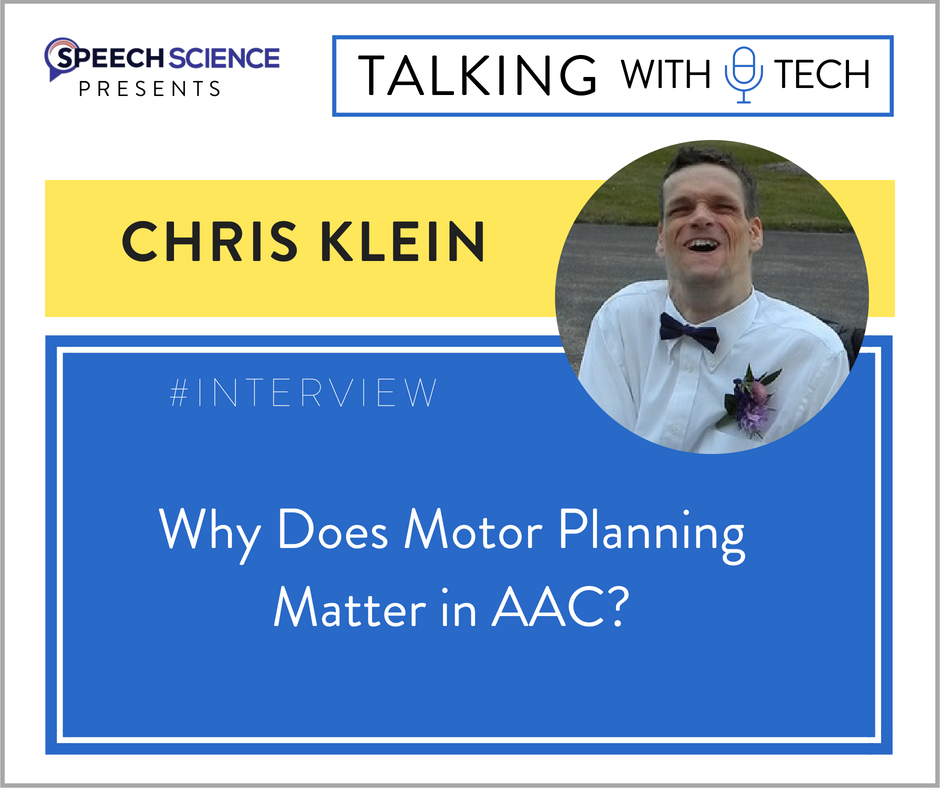
This week, Rachel, Lucas, and Chris discuss the implications of motor planning in instruction and use of Augmentative and Alternative Communication, including: Why motor planning is important, when to start considering a child’s motor plan, and practical ways to incorporate motor planning into your practice. Then Chris Bugaj is joined by Chris Klein, an educator, mentor, past president of the United States Society of Augmentative Alternative Communication (USSAAC), and founder of Building Connections with Others through Mentoring and Education about AAC (BeCOME AAC). Mr. Klein, an AAC user himself, is a voice for AAC users and individuals with disabilities everywhere; his thoughtful insights on motor planning are not to be missed!
We want to hear what you think! Join us on Facebook at Talking With Tech and on Instagram and Twitter @talkingwithtech. Don’t forget to subscribe and give us a rating on iTunes!
References
Dukhovny, E., & Zhou, Y. (2016). Effects of icon size and location on speed and accuracy of SGD access. Augmentative and Alternative Communication, 32(4), 241-248.
Dukhovny, E., & Gahl, S. (2014). Manual motor-plan similarity affects lexical recall on a speech-generating device: Implications for AAC users. Journal of communication disorders, 48, 52-60.
Wednesday May 30, 2018
Wednesday May 30, 2018
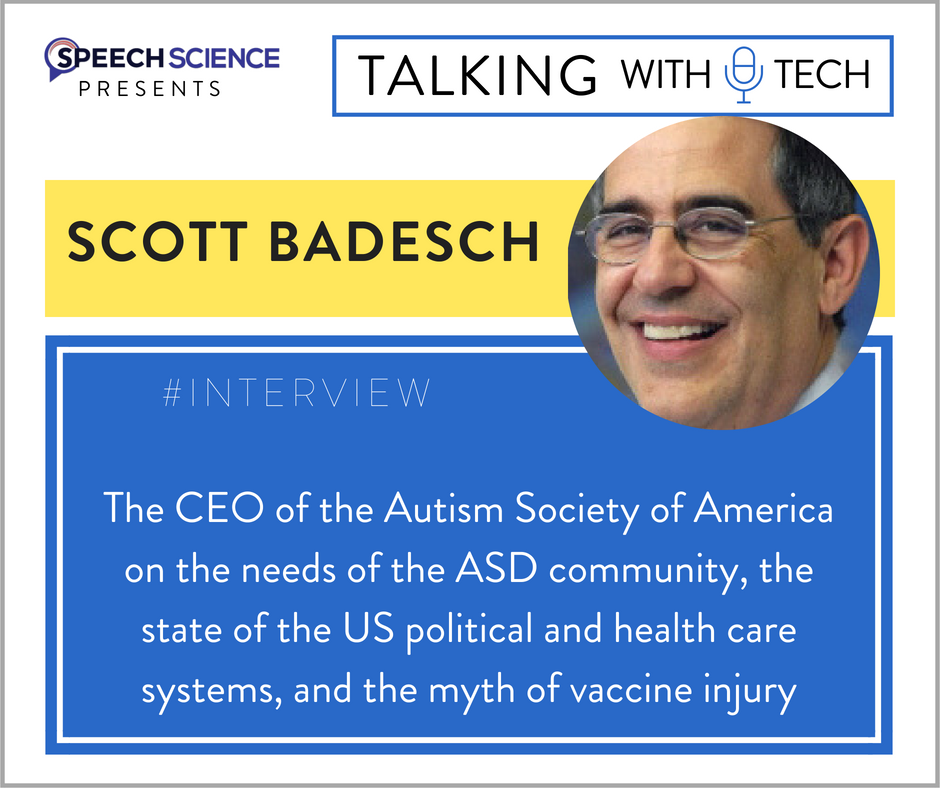
This week Scott Badesch, President and CEO of the Autism Society of America, sits down with Lucas to talk about the most urgent needs of those on the Autism spectrum, what the ASA's strategic plan is for the coming year, the critical state of the health care (and political) system in the United States, and the impact of vaccines on Autism (there isn't any).
Meanwhile, Chris and Rachel talk about unique considerations for AAC in the ASD population including strategic use - and avoidance - of preferred utterances and many more concerns.
You can contact Mr. Badesch via the Autism Society of America at http://www.autism-society.org/about-the-autism-society/staff/, and we also would love to hear your feedback and opinions! Come join us on Facebook, email us at tech@speechscience.org, or @talkingwithtech on Instagram or Twitter. Like what we do at Talking With Tech? Take a moment to leave us a review on iTunes as that helps others find us!
Tuesday May 22, 2018
Tuesday May 22, 2018
This week Rachel leads the team in a discussion of AAC for emergent communicators, focusing on early intervention through school-age children. Topics covered include the influence of AAC use on speech and language development, family and peer training, and a spirited debate about when to go high-tech - or not.
We'd love to hear your feedback and opinions! Come join us on Facebook, email us at tech@speechscience.org, or @talkingwithtech on Instagram or Twitter. Like what we do at Talking With Tech? Take a moment to leave us a review on iTunes as that helps others find us!
Research referenced in this episode includes:
Davidoff, B. E. (2017). AAC With Energy—Earlier: Research shows that children with communication challenges do best when introduced to augmentative and alternative communication as early as 12 months. The ASHA Leader, 22(1), 48-53.
Romski, M., Sevcik, R. A., Barton-Hulsey, A., & Whitmore, A. S. (2015). Early intervention and AAC: What a difference 30 years makes. Augmentative and Alternative Communication, 31(3), 181-202.
Join AAC experts Rachel Madel and Chris Bugaj as they dive into a weekly discussion about all things AAC (Augmentative and Alternative Communication). Every episode they deliver practical resources, clinical guidelines and relevant research to help clinicians better utilize technology for individuals with complex communication needs.
Episodes include interviews with industry thought-leaders, clinicians, parents, researchers and app developers to keep you on the pulse of the educational technology scene and better support communication through the use of technology.